
On September 10, a delegation of seven representatives from Southeast Asian countries—including Thailand, Laos, and Malaysia—visited the College of Environmental Sciences and Engineering (CESE) at Peking University (PKU). The visit, supported by Clean Air Asia (CAA), included in-depth discussions on pressing issues related to air pollution control and environmental health. The exchange and discussion involved CESE Professor Tong Zhu, Academician of the Chinese Academy of Sciences, Professor Shiqiu Zhang, Associate Professors Yue Qin, and Associate Professor Tao Xue from the School of Public Health (SPH), PKU.
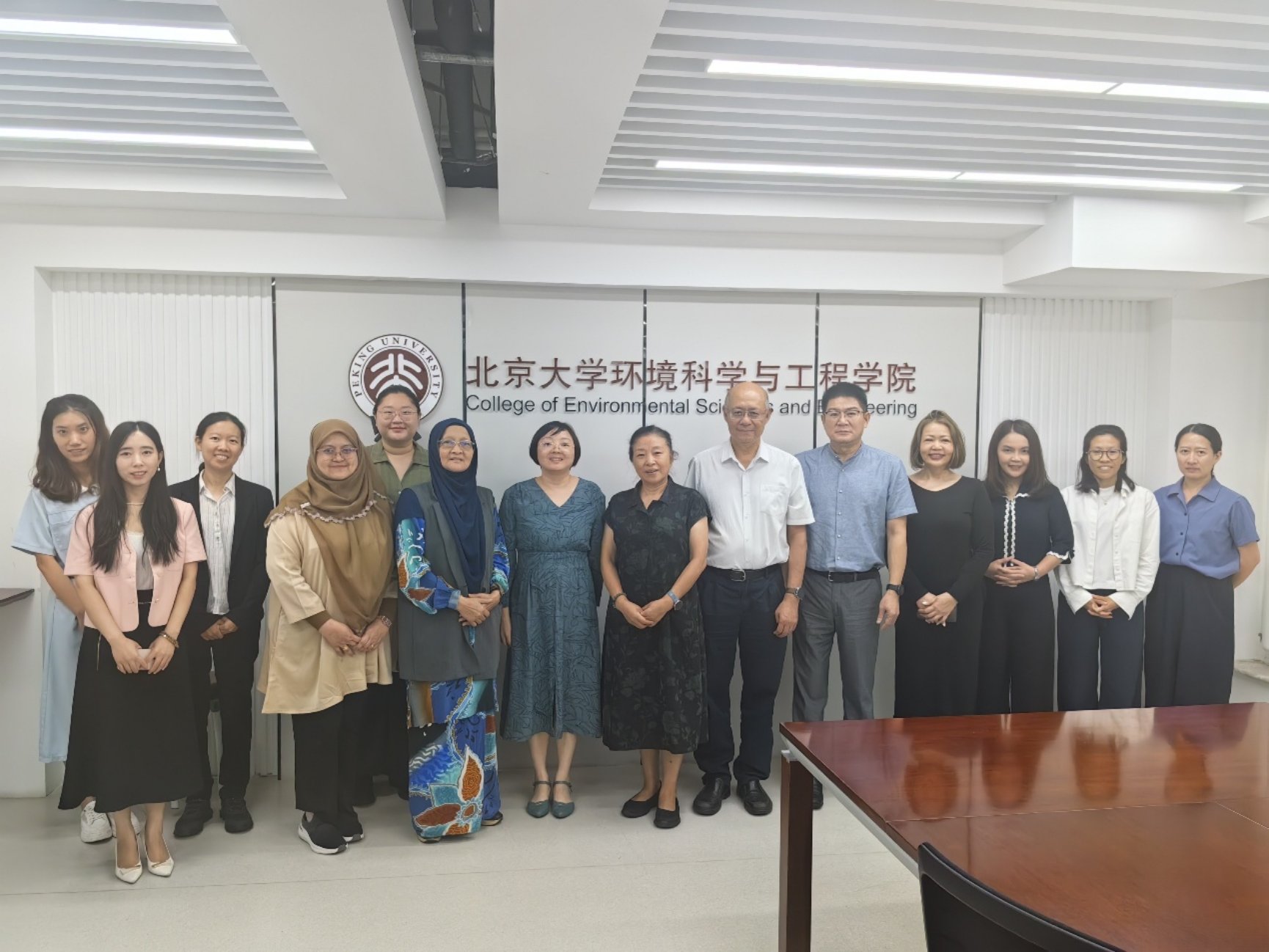
Professor Shiqiu Zhang chaired the meeting and warmly welcomed the delegates. She underscored the critical importance of evidence-based policymaking in the face of complex global environmental challenges and emphasized the role of regional cooperation in achieving clean air goals. Professor Tong Zhu highlighted the essential contribution of scientific research to air quality improvement and expressed hope that this visit would foster deeper collaboration between China and Southeast Asia in tackling air pollution and health-related issues. He also shared case studies illustrating how research outcomes have directly influenced policy and air quality improvement actions.
Associate Professor Tao Xue provided an overview of the Environmental Health Program at CESE, focusing on the health effects of air pollution and climate change, as well as integrated research and governance approaches within the Air-Climate-Health (ARCH) framework. Associate Professor Yue Qin, as Director of the Monsoon Asia Integrated Research for Sustainability - Future Earth (MAIRS-FE) Program, elaborated on its major research topics and capacity-building efforts. PhD candidate Ruohan Wang from SPH, PKU presented research findings from a health benefit assessment of China’s air quality improvements, demonstrating that clean air policies have led to significant reductions in pollution and notable gains in public health and equity.
During the discussion, representatives from Southeast Asian countries acknowledged China’s achievements in air pollution control and expressed keen interest in learning from its experience in turning research into policy. Conversations covered topics such as cross-border pollution, health impact assessments, and capacity building, with strong interest expressed in future collaboration with CESE in joint research, training, and technical exchanges. Dr. Wei Wan, Acting China Director of CAA, reaffirmed the organization’s commitment to facilitating China–Southeast Asia cooperation through knowledge-sharing and capacity building.
In his concluding remarks, Professor Tong Zhu underscored the need for building broad consensus across government and society to implement comprehensive and systematic strategies to reduce air pollution. He emphasized that China’s experience demonstrates how shifting from end-of-pipe pollution control to a health-driven approach can enhance coordinated governance of air quality and climate while safeguarding public health. He and the PKU team look forward to share insights and collaborate with Southeast Asian partners to translate research into concrete actions—advancing a cleaner and healthier future for Asia.
1
