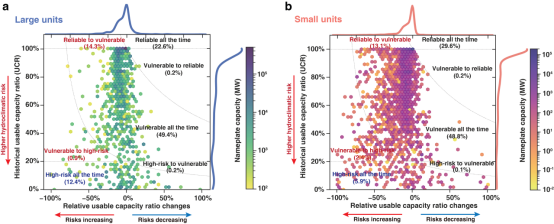

Hydroclimatic risks, such as increased water temperatures and water shortages, can impair the cooling efficiency of thermal power plants, threatening energy security. These risks worsen when decommissioning strategies for the low-carbon transition prioritize retiring smaller but lower-risk plants while keeping larger yet higher-risk ones. Yet, how hydroclimatic risks interact with these strategies remain poorly understood. Here we develop a global unit-level, capacity-specific framework to systematically assess hydroclimatic risks to thermal power generation under climate change. This framework maps risk intensification and risk-level escalation, and evaluates how integrating hydroclimatic risks into decommissioning plans can enhance energy security. We find that by the 2050s, ~60.5% of global thermal power capacity would face greater hydroclimatic risks under SSP370, as indicated by declining usable capacity ratios (UCRs)—the share of nameplate capacity that remains operable under hydroclimatic constraints. Integrating unit-level hydroclimatic risk constraints into decommissioning strategies could effectively raise the average UCRs of priority-retention units by 26–37 percentage points, although these units are typically slightly older. Our findings underscore the importance of incorporating hydroclimatic risks into decommissioning decisions to balance energy security and climate mitigation goals.