
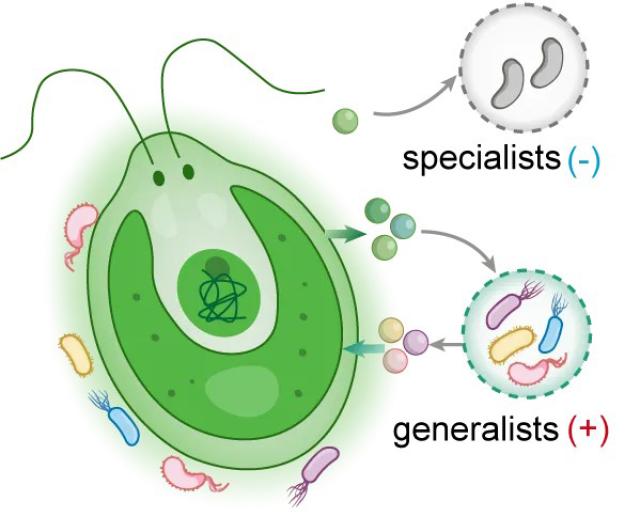
Phytoplankton–bacteria interactions are critical but often overlooked in assessing the impacts of pollutants onecosystems. Herein, we used a coculture consisting of the green alga Chlamydomonas reinhardtii and river bacte-ria to investigate their responses to antibiotic stress. Both partners exhibited hormesis in cocultures but wereinhibited in monocultures under exposure to 10 different antibiotics, especially azithromycin (AZM). Notably, mu-tualistic cooperation between the partners shifted the effect of AZM from inhibition in monocultures to promo-tion in cocultures. C. reinhardtii alleviates AZM stress on bacteria by providing organic carbon and efficientlyremoving antibiotics. In turn, the altered phycospheric bacteriome supplied ammonia, phosphate, vitamin B12 ,and indole- 3-acetic acid to promote C. reinhardtii growth. The antibiotic-induced growth promotion was also ob-served in natural phytoplankton–bacteria communities. Our findings challenge the reliability of ecotoxicity assess-ment that is typically based on single-species tests, emphasizing the importance of cross-kingdom interactions inassessing pollutant effects.
https://www.science.org/doi/epdf/10.1126/sciadv.adv7921
