
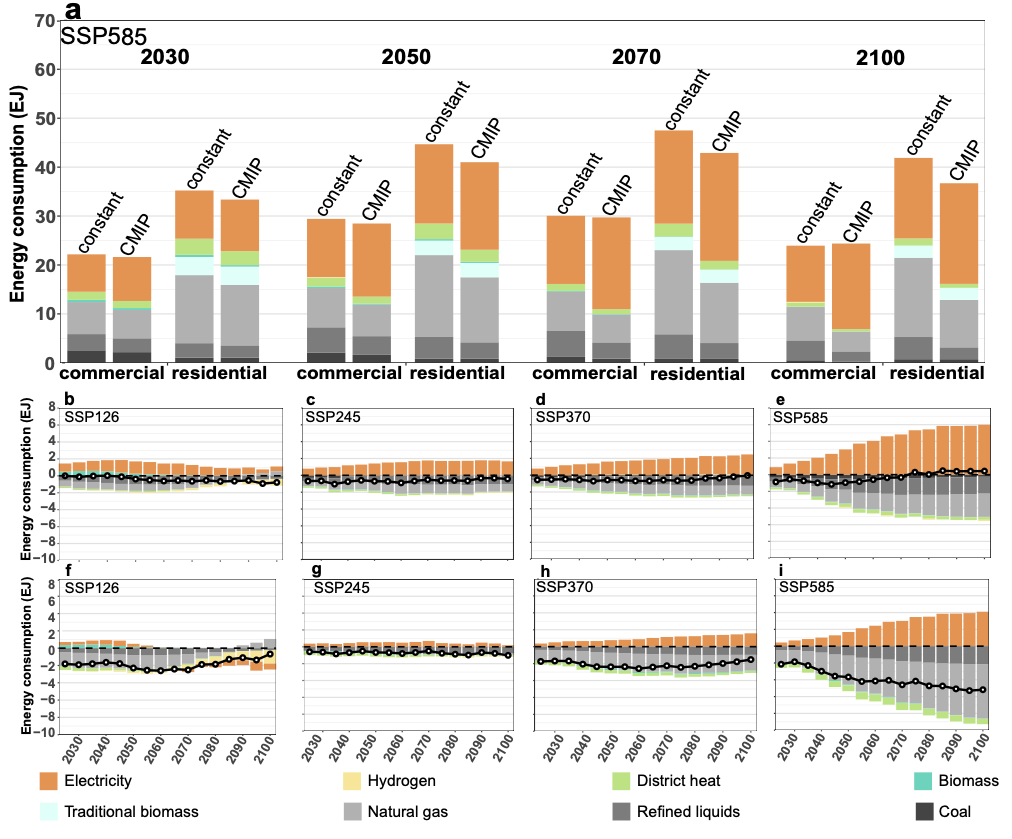
Global warming is reshaping energy demand in buildings, one of the largest sectors for energy consumption and CO2emissions. Yet widely used mitigation scenarios, such as those in the Shared Socioeconomic Pathways and Representative Concentration Pathways (SSP-RCP) framework, often assume fixed historical climate baselines when projecting building energy use. This modeling convention, originally intended to isolate anthropogenic effects, now increasingly overlooks how rising temperatures systematically alter heating and cooling needs. Here we integrate updated Heating and Cooling Degree Days, derived from the latest Coupled Model Intercomparison Project Phase 6 climate projections, into the Global Change Analysis Model to assess the consequences of incorporating future warming into global mitigation pathways. We find that ignoring warming trends introduces substantial biases: cooling demand is underestimated by up to 23% in scenarios with low warming and 79% in scenarios with high warming, while heating demand is overestimated by up to 14% and 40%, respectively, by 2100. Importantly, these misestimates reshape global energy and emissions trajectories, reducing CO2 emissions by 83–1600 Mt CO2 year−1 in 2100 when warming trends are included across different SSP-RCP scenarios, but also underestimating the rise in F-gas emissions related to cooling, especially in warmer developing regions.
https://www.nature.com/articles/s41467-026-74289-1
